

Construction Cost Location Factors

Easily Convert Capital Cost of Industrial Plants from One Country to Another
Construction cost location factors, also referred to as location factors or area cost factors, are multiplying factors for instantaneously translating the total overall construction cost of projects, from one geographic location to another. Location factors take into account various local components that contribute to construction costs, such as labor cost, material cost, logistic costs and business environment.
Such tools offer straightforward means to assess the relative variances in costs between two geographic locations, being useful in multiple studies including: economic evaluations, site selection studies, conceptual estimates, project planning. Construction cost location factors are commonly utilized in preliminary assessments to determine the viability of projects, and make early-stage “go/no go” decisions.
Construction cost location factors may be suitable for specific industries or sectors, and may be obtained from construction cost handbooks, industry reports, or online tools and databases. Intratec offers its Plant Location Factors (IL Factors) — today part of its Industry Economics & Competitiveness subscription — to convert construction costs of industrial plants among 33 countries worldwide.
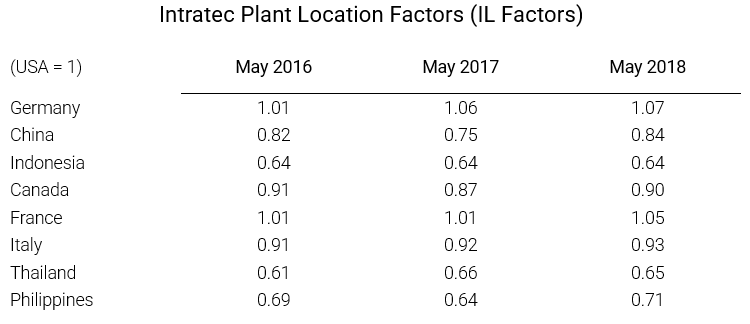
This article describes location factors provided by Intratec, how to use such tools and Intratec’s methodology for developing them.
Intratec Plant Location Factors (IL Factors)
IL Factors are monthly series of dimensionless multiplying factors calculated in a comparative manner. Each country's report uses its own country as the reference location (= 1.00) and publishes IL Factors that convert plant construction costs from every peer country into that country's terms. In this context, a factor greater than 1 indicates that construction costs in the report's country are higher than in the peer country, while a factor less than 1 indicates lower costs.
Intratec provides IL Factors for the 33 countries covered by the Industry Economics & Competitiveness program — subscribers simply pick the countries that matter to their business: Australia, Belgium, Brazil, Canada, Chile, China, Colombia, Czech Republic, Finland, France, Germany, Hungary, India, Indonesia, Italy, Japan, Mexico, Netherlands, Norway, Philippines, Poland, Russia, Saudi Arabia, Singapore, South Africa, South Korea, Spain, Sweden, Taiwan, Thailand, Turkey, United Kingdom, and United States.
IL Factors are available as part of the Industry Economics & Competitiveness subscription:
Industry Economics & Competitiveness
Using Intratec Plant Location Factors
Intratec Plant Location Factors usage is straightforward. To translate a plant cost from a peer country into the report country's terms, multiply the known plant cost by that peer country's IL Factor in the specific period.
Cost in Report Country = Peer Country's Plant Cost × IL Factor of that Peer Country
Example. A research group would like to assess the construction cost of a chlor-alkali plant in April 2017 in Brazil. A similar study was already made in the United States in the same period, and the plant cost was estimated at USD 100 million.
To convert plant cost estimates from the US to Brazil, you just have to multiply the plant cost in April 2017 in the USA (USD 100 million) by the US IL Factor published in Brazil's report for April 2017 (1.09), as expressed in the equation below:
Plant Cost in Brazil[Apr 2017] = Plant Cost in the US[Apr 2017] × US IL Factor[Apr 2017]
By applying this calculation, the plant cost in Brazil in April 2017 would be approximately USD 109 million.
How Intratec Plant Location Factors Are Calculated
The Intratec Plant Location Factors are compiled based on a structured methodology, which involves gathering and processing a huge amount of economic parameters that are categorized into four major components, as follows:
Labor cost. It includes wage rates, directly paid benefits, and other expenditures incurred by the employer to employ a worker, as well as the difference in local productivity data.
Material cost. It considers steel prices, import needs, availability of local equipment, need of spare equipment, and freight, taxes, and duties on imported and domestic materials.
Logistic costs. It refers to all costs associated with a country’s infrastructure, such as: availability and quality of ports, roads, airports, and rails; communication technologies; warehouse infrastructure; border clearance; and local incentives.
Business environment. It takes into account the costs associated with doing business in the country, such as: readiness of bureaucratic procedures; legal protection of investors; enforcing contracts; and getting credit.
All components that make-ups the previous major components are then weighted according to their relative importance. Finally, the factors are calculated in a comparative manner, with each country's report taking its own country as the reference location.
About Intratec Solutions
Intratec Solutions — Independent Commodity, Energy & Industrial Intelligence. In operation since 2002, Intratec turns complex commodity and industrial data into clear, comparable intelligence. Its AI-enabled products cover prices, market dynamics, production economics, and the broader conditions that shape competitiveness. More at intratec.us.